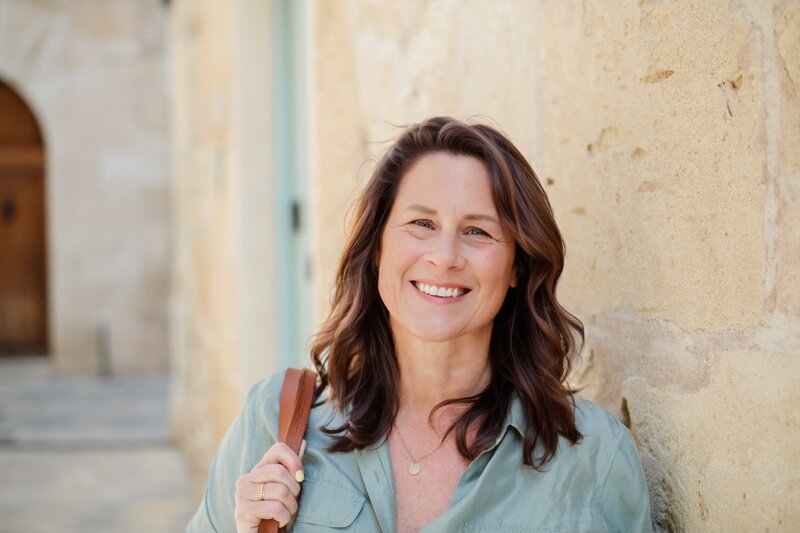
There are conversations that stay with you long after the recording stops, and my interview with Kamala Rose was one of them.
Kamala is a yoga philosophy educator based in Louisville, Kentucky. She spent over 30 years living in an ashram, took monastic vows in her 20s, ran charity food programs, taught at universities, and dedicated her entire life to the yoga tradition. Then, in her mid-50s, she left. No computer skills, no social media, no website. Just decades of wisdom and the quiet certainty that she was meant to share it with more people than the walls of a monastery would allow.
She calls it going from monastery to marketplace, and listening to her talk about it, I kept thinking: this is what dharma actually looks like in practice.
The texts most yoga teachers own but never really read
Kamala teaches both the Bhagavad Gita and the Yoga Sutra, and she made a point in our conversation that I think will resonate with a lot of you. Most yoga teachers graduate from their training with these two texts in their hands and very little understanding of what they actually say. Not because they aren’t smart or dedicated, but because nobody ever taught them how to read them.
The Yoga Sutra, written around 200 CE, is essentially a manual for the inner life, for what happens inside the mind on a meditative, renunciate path. The Bhagavad Gita, written roughly 500 years earlier, is something different entirely. It’s asking us to be engaged in the world, to bring our gifts into it, to help other people with them. That distinction matters, especially if you’re a yoga teacher trying to reconcile a deep spiritual practice with the very practical reality of building a business.
Why the battlefield scene is actually about you
One of the things Kamala addresses often, especially with women, is the opening of the Gita: Arjuna on the battlefield, dropping his bow, unable to figure out the right thing to do. It can feel remote, even alienating, for modern women who will never find themselves in an actual military conflict.
But Kamala reframes it beautifully. That moment of paralysis, of not knowing whether to move forward or stay, of loyalty pulling in multiple directions at once, is one most of us know intimately. It’s the moment right after a teacher training ends and you’re wondering whether you’re actually ready to teach. It’s the moment you realize you’ve outgrown the path you were on and something new hasn’t fully formed yet. The Gita doesn’t promise certainty. It offers a framework for sitting with the not-knowing and moving anyway.
Where to start if the texts feel intimidating
If you’ve ever picked up the Yoga Sutra and felt lost after the first page, Kamala’s advice is simple: start where you already feel at home. Go to the section on asana and pranayama in the second chapter. Read what you already know and let the text become familiar before you try to wrestle with the harder parts.
For the Bhagavad Gita, she recommends Stephen Mitchell’s translation for its accessibility and poetry, and suggests starting not at the beginning with the battlefield, but at chapter six, which covers meditation and the seated posture, and chapter ten, which is pure poetry. Make a friend of the text first, she says, and you’ll go much further than if you try to understand everything at once.
What 30 years in an ashram and one year building a business have in common
What struck me most in our conversation was the way Kamala held both things at once: the deep, unhurried wisdom of someone who has spent decades in serious study, and the very real vulnerability of someone who is brand new to Instagram, to online courses, to all of it.
She talked about coming home to the philosophy when things feel hard. About the practice being the stable thing when everything else, the new city, the new work, the new world, is shifting underneath her. And I think that’s the most honest thing anyone has ever said on this podcast about what yoga philosophy is actually for. Not for enlightenment as a distant abstract goal, but for right now, when you don’t know what to do and you need something that holds.
Kamala runs a free Women’s Gita Circle every two weeks on Zoom, which she describes as an hour of reading a verse together and modeling for each other that we don’t have to know it all, we just have to be willing to engage. Her 12-week course Sutra to Self covers Sanskrit literacy, the foundations of yoga philosophy, and a slow guided reading of the Yoga Sutra.
You can find her at kamalaroseyoga.org and on Instagram at kamalarose.yoga. I hope you’ll reach out to her. She’s one of the real ones.